

How To Set Architectural Units In Autocad
Speaking of millimeters, here's another choice you take to make even earlier y'all cull your units of mensurate — and that's your arrangement of mensurate.
Most of the earth abased local systems of measure generations agone. Fifty-fifty widely adopted ones, like the Imperial system, have generally fallen by the wayside (just like their driving force, the British Empire) — except, of class, in the U.s.a., where feet, inches, pounds, gallons, and degrees-Fahrenheit still rule.
Make certain anybody agrees on the units existence used. NASA once crashed a very expensive space probe onto Mars because of a mix-upwardly between royal versus metric systems.
During drawing setup, you choose settings for length units (for measuring linear objects and distances) and angle units (for measuring angles between nonparallel objects or points on arcs or circles) in the Drawing Units dialog box. AutoCAD's length unit types are equally follows:- Architectural units are based in feet and inches and use fractions to represent fractional inches: for instance, 12′3 one/2″. The base unit is the inch unless otherwise specified, and then if yous enter a number similar 147.five, so AutoCAD volition understand it to be 12′3 1/2″.
- Decimal units are unitless — that is, they're not based on any particular real-world unit of measurement. With decimal units, each unit in the drawing could represent an inch, a millimeter, a parsec, a furlong, a fathom, a cubit (if you're into building arks in instance that rainy day should come), or whatsoever other unit of measure y'all deem suitable, from Danish alens to the Swiss zoll. An example would exist xv.five.
- Engineering units are based in feet and inches and use decimals to represent partial inches: for example, 12′three.5″.
- Fractional units, like decimal units, are unitless and prove values as fractions rather than decimal numbers: for instance xv i/2.
- Scientific units, also unitless and show values as exponents, are used for drawing really tiny or really large things. If you design molecules or galaxies, this is the unit type for y'all. Examples would be 15.5E+06 (which is 15,500,000) and 15.5E–06 (which is 0.0000155).
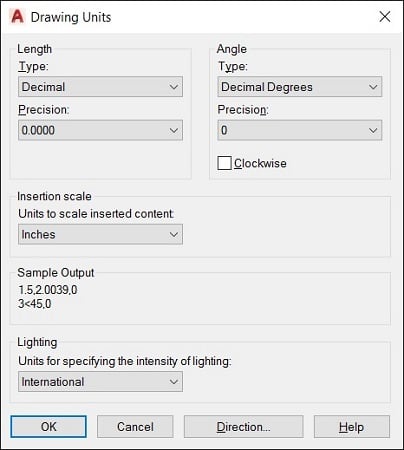
The Drawing Units dialog box.
AutoCAD's bending unit types are as follows:
- Decimal Degrees evidence angles as decimal numbers and are past far the easiest to work with, if your type of work allows it.
- Deg/Min/Sec is based on the old style of dividing a degree into minutes and minutes into seconds. Seconds aren't fine plenty to display AutoCAD's precision capabilities, though, so seconds can exist further divided into decimals. There is no degree symbol on a standard keyboard, so AutoCAD uses the lowercase letter d. An example would be 45d30′10.7249″. I nautical mile (6,076 feet) is approximately ane minute of arc of longitude on the equator. David Letterman once said that the equator is then long that information technology would attain one time around the world.
- Grads and Radians are mathematically beautiful but are non widely used in drafting. In that location are 400 grads, and 2*pi (six.2831…) radians, in a circle.
- Surveyor'south Units type is like to Deg/Min/Sec but uses quadrants (quarter circles) rather than a whole circle. An angle in Deg/Min/Sec might measure out 300d0′.00″, while the same bending in Surveyor's Units would be represented as S 30d0′0.00″ E.
The unit types y'all'll nigh probable utilize are Decimal, Architectural, and Decimal Degrees. You'll know or be told if you need to use one of the other types.
AutoCAD always works internally to something like 16-digit accuracy. Changing the type of units changes but how values are displayed, suitably rounded off. For example, a line that's 15.472563 decimal units long would brandish as 12″iii i/2″ long when units are changed to Architectural. The bodily length — and whatsoever calculations based on it — remains at 15.472563 and does non change to 15.5″.
When you lot utilize dash-dot linetypes and hatching in a cartoon, it matters to AutoCAD whether the drawing uses an Imperial (inches, feet, miles, and and so on) or metric (millimeters, meters, kilometers, and so on) system of mensurate. The MEASUREINIT and MEASUREMENT system variables control whether the linetype and hatch patterns that AutoCAD lists for y'all to cull from are scaled with inches or millimeters in mind as the plotting units.For both variables, a value of 0 (zero) means inches (that is, an Imperial-units cartoon), whereas a value of 1 means millimeters (that is, a metric-units drawing). If you outset from an advisable template drawing, the organisation variable values volition be set correctly, and you won't e'er have to think nigh it.
So why are there two variables? Simple. MEASUREINIT (short for measurement initial) sets the default value for all new drawings, and MEASUREMENT changes the value for the current cartoon.
AutoCAD automatically sets the measurement organization co-ordinate to your country when it's beingness installed, but it can be changed.
Virtually This Article
This article tin be found in the category:
- AutoCAD ,
Source: https://www.dummies.com/article/technology/software/design-software/autocad/choosing-units-autocad-221298/
0 Response to "How To Set Architectural Units In Autocad"
Post a Comment